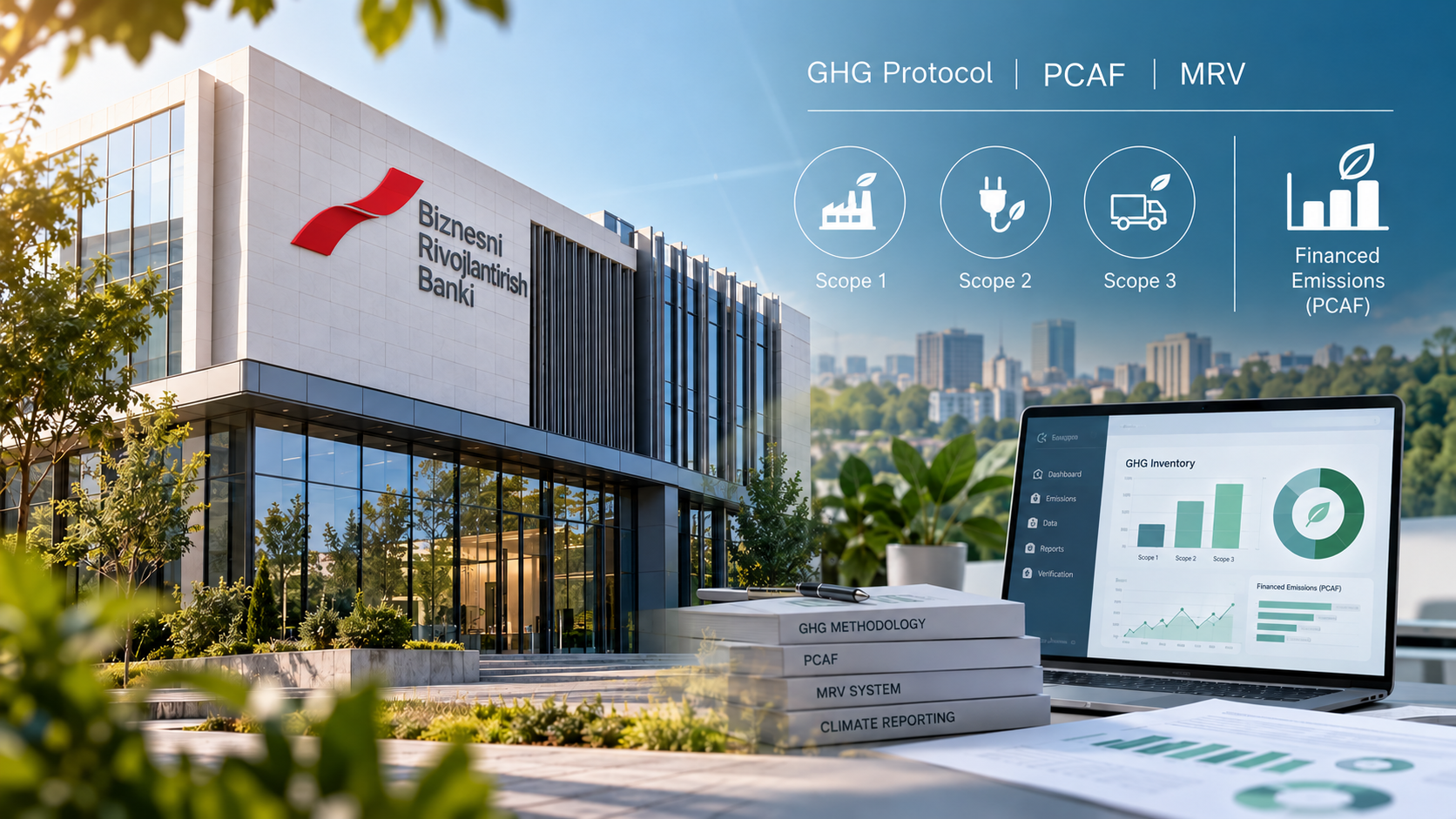
- Focus Area: Climate and ESG, decarbonization, corporate carbon accounting, GHG Protocol, PCAF, MRV digitalization, sustainable finance, climate reporting
- Facility Type: Banking institution / operational activities and loan portfolio
- Reporting Period: 2025
- Location: Republic of Uzbekistan
- Client: JSCB Business Development Bank (BRB)
- HPBS Role: Consultant for corporate carbon accounting, financed emissions calculation, and development of methodology and technical documentation for a corporate MRV system
- International Standards: GHG Protocol Corporate Accounting and Reporting Standard, ISO 14064-1:2018, PCAF Global GHG Accounting and Reporting Standard
- Result: A comprehensive methodology for the Bank’s greenhouse gas emissions inventory covering Scope 1, Scope 2, and Scope 3, including financed emissions from the loan portfolio in accordance with PCAF, was developed. Calculation algorithms, electronic models, the 2025 GHG inventory, and methodological and technical documentation for a digital corporate MRV system (Monitoring, Reporting and Verification) were prepared. Training was provided to the Bank’s specialists.
About the Project
JSCB Business Development Bank (BRB) implemented a project to establish a corporate greenhouse gas emissions accounting system aimed at enhancing the transparency of climate reporting, managing climate indicators, and developing sustainable finance instruments. Particular attention was paid to implementing international GHG Protocol and PCAF approaches, defining organizational accounting boundaries, assessing the materiality of emission sources, developing calculation algorithms, and improving the quality of input data.
A separate area of work involved developing the methodological and technical framework for a digital MRV system, ensuring monitoring, reporting, data traceability, and preparation of results for independent verification. The project establishes a foundation for the further digitalization of the Bank’s climate-related business processes, the integration of carbon accounting into corporate governance, ESG reporting, and climate risk management, as well as compliance with applicable government requirements and the requirements of international development institutions.
Our Services Included
1. Development of a Greenhouse Gas (GHG) Emissions Inventory Methodology
- Development of a corporate methodology for quantifying greenhouse gas emissions in accordance with the GHG Protocol Corporate Accounting and Reporting Standard and ISO 14064-1:2018;
- Definition of organizational and operational boundaries for the inventory;
- Identification of emission sources and their classification into Scope 1, Scope 2, and Scope 3;
- Conducting a materiality assessment of emission sources, including the Bank’s operational and financed activities;
- Development of approaches to collecting, processing, verifying, and consolidating input data for 2025;
- Definition of methodological requirements for calculations, selection of emission factors, and documentation of results.
2. Calculation of Scope 1, Scope 2, and Scope 3 Emissions, Including Financed Emissions in Accordance with PCAF
- Development of algorithms for calculating direct Scope 1 emissions from sources owned or controlled by the Bank;
- Definition of approaches to calculating indirect energy-related Scope 2 emissions associated with the consumption of purchased energy;
- Assessment of material Scope 3 categories, including business travel, employee commuting, and financed activities;
- Development of a methodology for accounting for financed emissions from the loan portfolio in accordance with the PCAF Global GHG Accounting and Reporting Standard;
- Definition of approaches to calculating emissions for the relevant financial asset classes;
- Application of emission factors, financial and sector-specific indicators in calculation models;
- Implementation of approaches to assessing the reliability and completeness of input data using the PCAF Data Quality Score;
- Development of calculation algorithms and electronic models for preparing the corporate emissions inventory.
3. Development of Methodological and Technical Documentation for the Corporate MRV System
- Development of the methodological and technical framework for a digital Monitoring, Reporting and Verification (MRV) system;
- Description of greenhouse gas emissions calculation algorithms and requirements for their automation;
- Establishment of requirements for integrating the MRV system with the Bank’s internal information resources;
- Development of requirements for data structures and standardized forms for data collection, uploading, and processing;
- Definition of mechanisms to ensure data traceability from primary sources to final emissions indicators;
- Development of requirements for automated data validation and identification of missing data and errors;
- Definition of requirements for maintaining a correction log and managing calculation versions;
- Establishment of functional requirements for climate reporting, storage of supporting documents, and preparation of results for independent verification.
4. Preparation of Climate Reporting and Training of Bank Employees
- Preparation of the Bank’s greenhouse gas emissions inventory for 2025;
- Preparation of reporting materials and calculation models for subsequent monitoring of climate indicators;
- Development of methodological materials on the application of GHG and PCAF calculation algorithms and MRV procedures;
- Provision of training to the Bank’s specialists on greenhouse gas emissions calculations and the application of international methodologies;
- Training on the principles of organizing data collection and preparing climate reporting;
- Transfer of the developed methodological materials and project results for their practical application by the Bank.
Project Results
As a result of the project implementation, JSCB Business Development Bank obtained a comprehensive methodological and technical framework for corporate carbon accounting and the digitalization of greenhouse gas emissions monitoring processes.
Key Results:
- GHG Inventory 2025: The Bank’s greenhouse gas emissions inventory for 2025 was prepared, covering Scope 1, Scope 2, and material Scope 3 categories.
- PCAF — Financed Emissions: A methodology for calculating financed emissions from the loan portfolio was developed, taking into account financial asset classes and the quality of input data.
- GHG Calculation Models: Algorithms and electronic models for calculating greenhouse gas emissions were prepared.
- Corporate MRV System: Methodological and technical documentation was developed for the creation of a digital corporate Monitoring, Reporting and Verification system.
- Data Quality & Traceability: Requirements for data quality control, calculation traceability, documentation, and preparation for independent verification were defined.
- Climate Reporting: Reporting materials were prepared for subsequent monitoring of climate indicators.
- Capacity Building: Training was provided to the Bank’s employees on international GHG Protocol and PCAF methodologies and corporate MRV procedures.
The project established a foundation for transitioning from individual carbon footprint calculations to systematic climate data management, their subsequent digitalization, and their use in ESG reporting. The developed methodologies and technical solutions can be applied by the Bank for regular emissions inventories, monitoring the carbon footprint of its loan portfolio, improving the quality of climate information, and further developing sustainable finance instruments.
Status: Completed project involving the development of a GHG methodology, calculation of PCAF financed emissions, preparation of climate reporting for 2025, and technical documentation for a corporate MRV system.
Additional Information