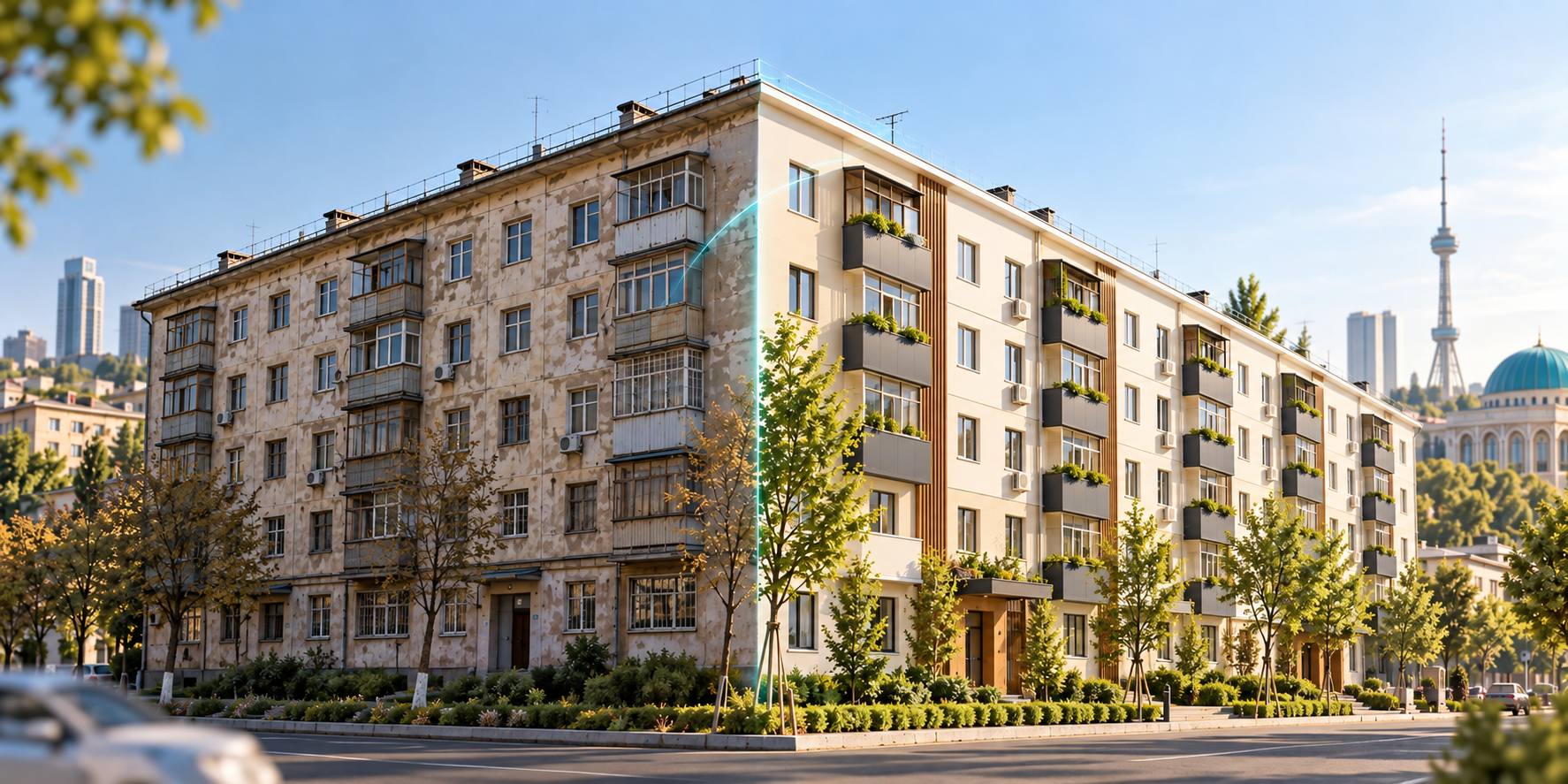
Can the modernization of old residential buildings really reduce greenhouse gas emissions?
A study conducted by HPBS specialists in collaboration with academic partners, using apartment buildings in Tashkent as an example, showed that building insulation reduces annual CO₂ emissions by 13.5%. However, the environmental impact must be assessed considering the entire building life cycle, including the production of construction materials.
The research results were published in the international scientific journal E3S Web of Conferences in 2024.
Carbon Footprint of Residential Buildings in Tashkent
The study examined 33 Soviet-era apartment buildings in the Labzak residential area of Tashkent. To assess the environmental impact of renovation, the Life Cycle Assessment (LCA) method was applied in accordance with ISO 14040/14044.
Two scenarios were considered: operating the building without modernization and renovating it with additional insulation of external walls, attic floors, and floors above the basement.
Key Research Results
| Indicator | Result |
| Reduction in annual CO₂ emissions after insulation | 13.5% |
| Annual emissions reduction | 1.58 t CO₂e |
| Thermal energy savings | 4.07 Gcal/year |
| Carbon footprint of insulation production during the initial renovation | 25 t CO₂e |
| Carbon payback period | 17 years |
| Reduction in cumulative emissions over 60 years | 43.2 t CO₂ |
The calculations showed that renovating one typical building reduces annual heating-related emissions from 11.69 to 10.11 tonnes of CO₂e.
At the same time, the production of thermal insulation materials itself generates greenhouse gas emissions. Over the calculated 60-year building life cycle, the carbon footprint of insulation, including its replacement, amounts to approximately 50 tonnes of CO₂e.
Therefore, to assess the actual environmental impact, it is necessary to consider not only the reduction in energy consumption but also the so-called embodied carbon of construction materials.
Key Conclusions for Uzbekistan’s Construction Industry
The study confirms that improving the energy efficiency of existing buildings contributes to the decarbonization of the residential building stock. However, insulation alone is insufficient to achieve significant emissions reductions across the construction sector.
A comprehensive approach is required, including building Life Cycle Assessment (LCA), accounting for the carbon footprint of construction materials, improving the efficiency of heat supply systems, and applying low-carbon technologies.
Of particular importance for Uzbekistan is the development of a national database of Environmental Product Declarations (EPDs) and tools for calculating the embodied carbon of construction materials.
Key takeaway: An energy-efficient building does not always mean a building with the lowest carbon footprint. The actual climate impact must be calculated over the entire life cycle.
Scientific Publication
Life Cycle Analysis of a Renovation Project for Old Housing in Tashkent to Reduce Greenhouse Gas Emissions. Authors: Elyor Makhmudov, Anna Zavaleeva, Ilya Zavaleev, Akmal Berdimurodov. E3S Web of Conferences, Volume 574, 05007 (2024), CONGREENTAX-2024.
Download the full scientific article (PDF, English)
HPBS provides building carbon footprint calculations, Life Cycle Assessment (LCA), greenhouse gas emissions assessments, and develops solutions to improve energy efficiency and decarbonize real estate assets. Contact HPBS: info@hpbs.uz, Telegram: +998 90 930 65 66.
Additional Information: