Focus area: climate and decarbonization, greenhouse gas emissions accounting, energy efficiency, and ESG
Organization type: state-owned enterprises / transport and postal infrastructure
Location: Republic of Uzbekistan
Client: Expertise France
HPBS role: climate consultant / contractor for carbon footprint assessment and the development of decarbonization recommendations
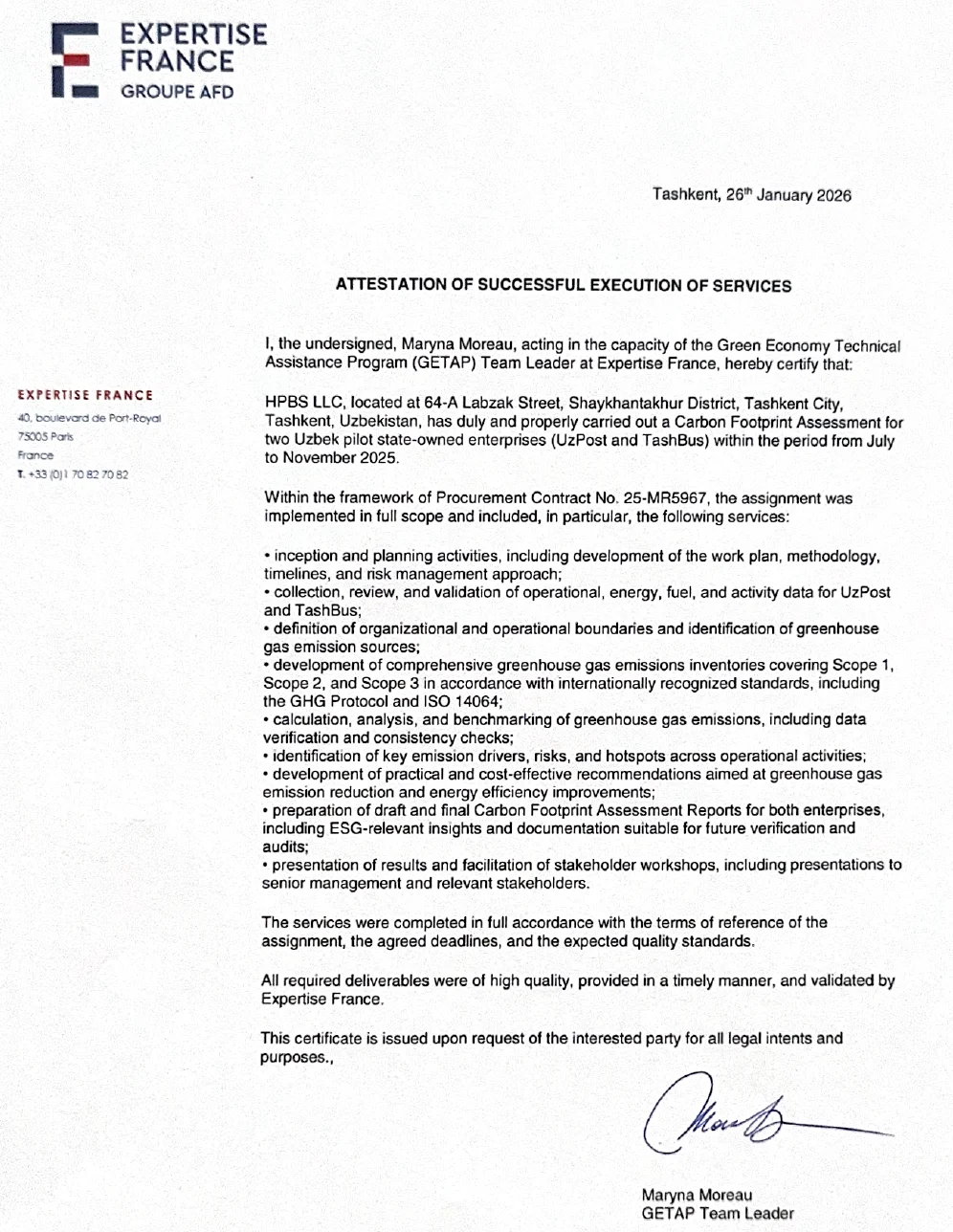
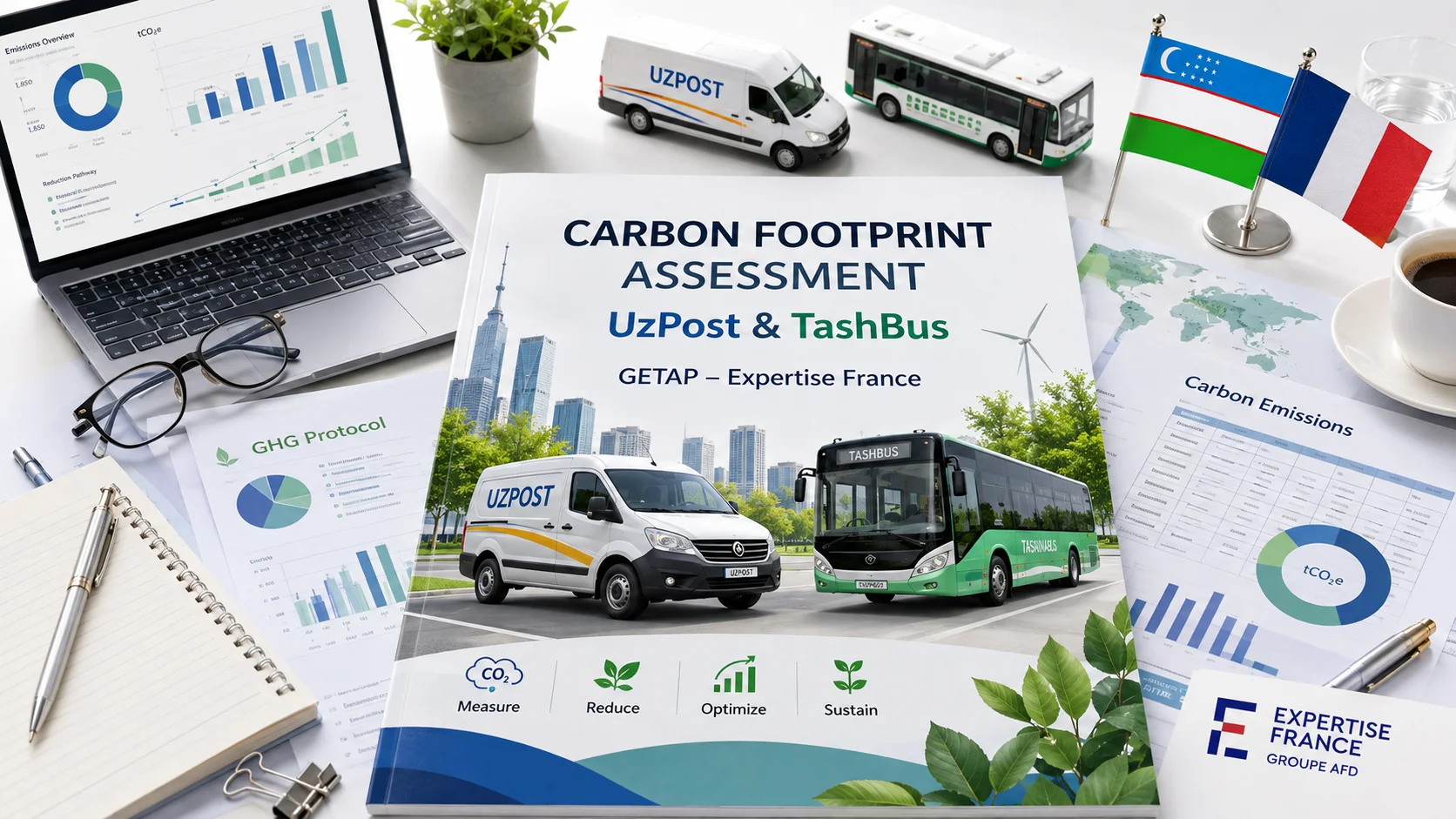
Result: a carbon footprint assessment was conducted for two pilot state-owned enterprises — UzPost and TashBus — with calculation of Scope 1, Scope 2, and relevant Scope 3 categories, identification of key emission sources, and development of recommendations for reducing them.
The Carbon Footprint Assessment for UzPost and TashBus under the Green Economy Technical Assistance Program project was implemented for Expertise France as part of technical assistance for the development of a green economy in Uzbekistan.
The project’s main objective was to create a practical basis for greenhouse gas emissions management at major state-owned enterprises. This required not only calculating the companies’ current carbon footprints, but also identifying the main emission sources, determining the areas with the greatest reduction potential, and developing recommendations for decarbonization and improved energy efficiency.
UzPost, representing the country’s postal and logistics infrastructure, and TashBus, operating in urban passenger transport, were selected as the pilot enterprises.
Our role
HPBS performed a comprehensive greenhouse gas emissions assessment for the two state-owned enterprises, including analysis of their organizational structures and assets, definition of accounting boundaries, methodology development, data collection and validation, emissions calculations, and preparation of carbon-footprint reduction recommendations.
The project’s methodological framework was developed with due regard to the principles of the GHG Protocol and ISO 14064.
Particular attention was paid to ensuring that the calculation results could be used by the enterprises as a practical management tool: to identify priority emission sources, plan energy-efficiency measures, prepare decarbonization programs, and further integrate climate and ESG indicators into corporate governance.
Our services:
-
analysis of the organizational structure, assets, and operating activities of UzPost and TashBus;
-
definition of organizational and operational boundaries for emissions accounting;
-
development of a corporate greenhouse gas inventory methodology;
-
identification of Scope 1, Scope 2, and relevant Scope 3 emission sources;
-
development of forms and tools for collecting source data;
-
collection, review, and validation of enterprise data;
-
calculation of direct and indirect greenhouse gas emissions;
-
systematization of GHG inventory results;
-
identification of the most significant emission sources and areas of climate impact;
-
comparative analysis and benchmarking of indicators;
-
assessment of emissions-reduction potential;
-
development of decarbonization recommendations;
-
development of recommendations for improving energy efficiency;
-
identification of potential areas for upgrading equipment, vehicles, and infrastructure;
-
preparation of recommendations for integrating climate and ESG indicators into corporate governance processes;
-
preparation of final reports for each enterprise;
-
presentation of results to management and stakeholders;
-
working and training sessions on greenhouse gas emissions accounting and management.
Carbon footprint assessment scope
The project covered several levels of corporate emissions accounting and management:
-
Scope 1 — direct emissions from sources controlled by the enterprises;
-
Scope 2 — indirect emissions associated with the consumption of purchased electricity and other forms of energy;
-
Scope 3 — relevant indirect emissions in the value chain;
-
GHG Accounting — establishment of a corporate emissions calculation and accounting system;
-
Emission Hotspots — identification of key sources and the most carbon-intensive processes;
-
Energy Efficiency — identification of measures to reduce energy and resource consumption;
-
Decarbonization — formulation of practical measures to reduce the carbon footprint;
-
ESG Integration — use of climate indicators in subsequent corporate planning and reporting.
Result
The project established a basic corporate carbon footprint assessment system for UzPost and TashBus, including the methodology, accounting boundaries, source data, and calculations for Scope 1, Scope 2, and relevant Scope 3 categories.
The main emission sources were identified for each enterprise, and practical recommendations were prepared for reducing them, improving energy efficiency, and further developing the climate management system.
The project results were presented to enterprise management and stakeholders and can be used as a basis for subsequent emissions monitoring, climate target-setting, and the development of longer-term decarbonization programs.
Project significance
For Uzbekistan’s state-owned enterprises, establishing a reliable emissions accounting system is the first stage in progressing from individual environmental measures to systematic carbon management.
The Expertise France project demonstrated how international greenhouse gas accounting methodologies can be adapted to the actual structure of the assets and operating activities of enterprises in Uzbekistan’s transport and infrastructure sectors.
Using UzPost and TashBus as examples, a practical model was created for progressing from data collection and carbon footprint calculation to identifying investment and technological opportunities for emissions reduction.
For HPBS, this project confirms the company’s expertise in GHG Accounting, Scope 1–3, decarbonization, energy efficiency, and ESG, as well as its experience in implementing international technical-assistance projects for major state-owned enterprises in Uzbekistan.