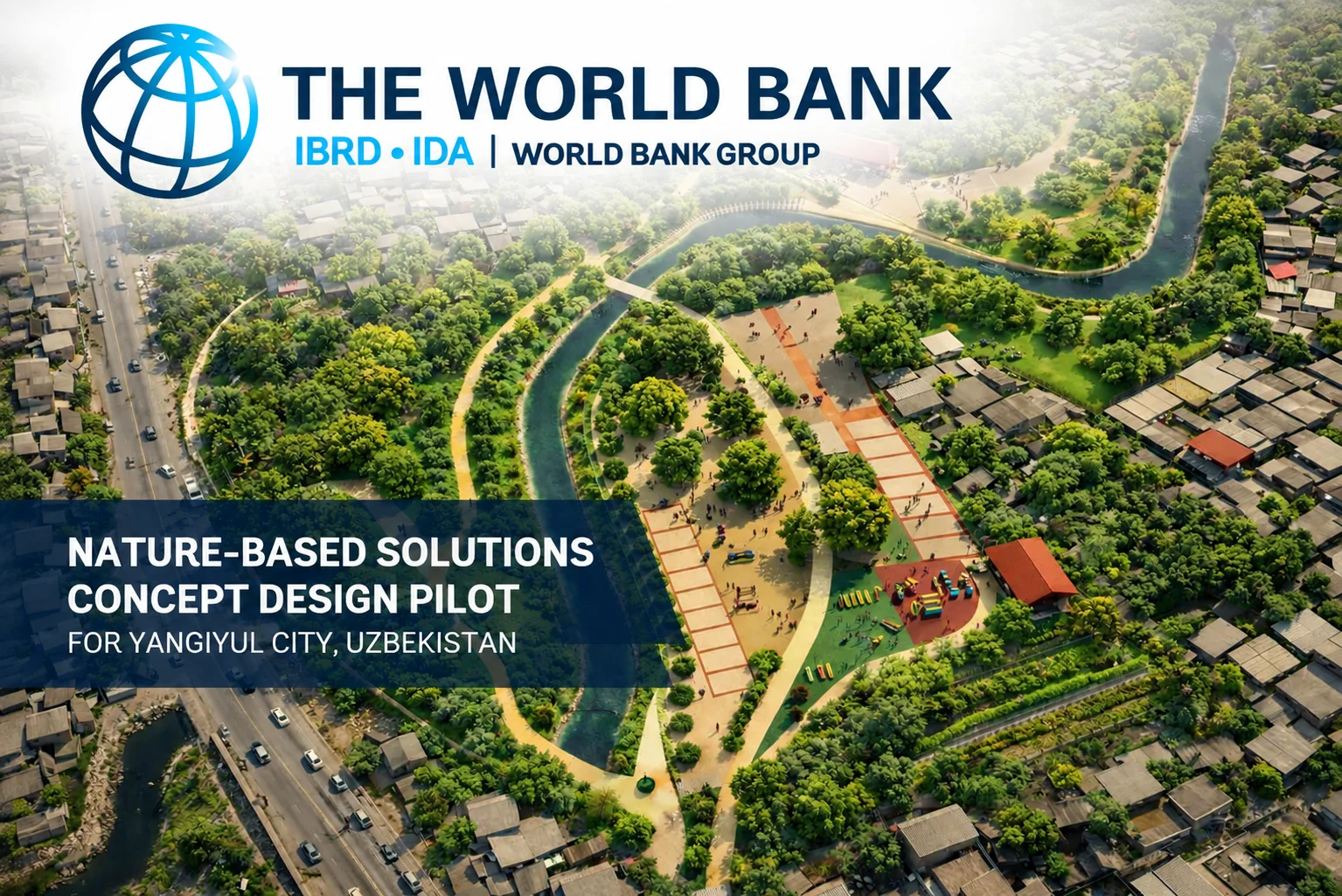
Focus area: Nature-Based Solutions (NBS), sustainable urban development, and adaptation to climate risks
Property type: urban areas / public spaces / environmental rehabilitation areas
Location: Yangiyul, Republic of Uzbekistan
HPBS role: Nature-Based Solutions consultant / developer of conceptual solutions and recommendations for integrating NBS into the urban environment
Result: development of a conceptual approach and a catalog of nature-based solutions for priority urban areas in Yangiyul as part of a World Bank project.
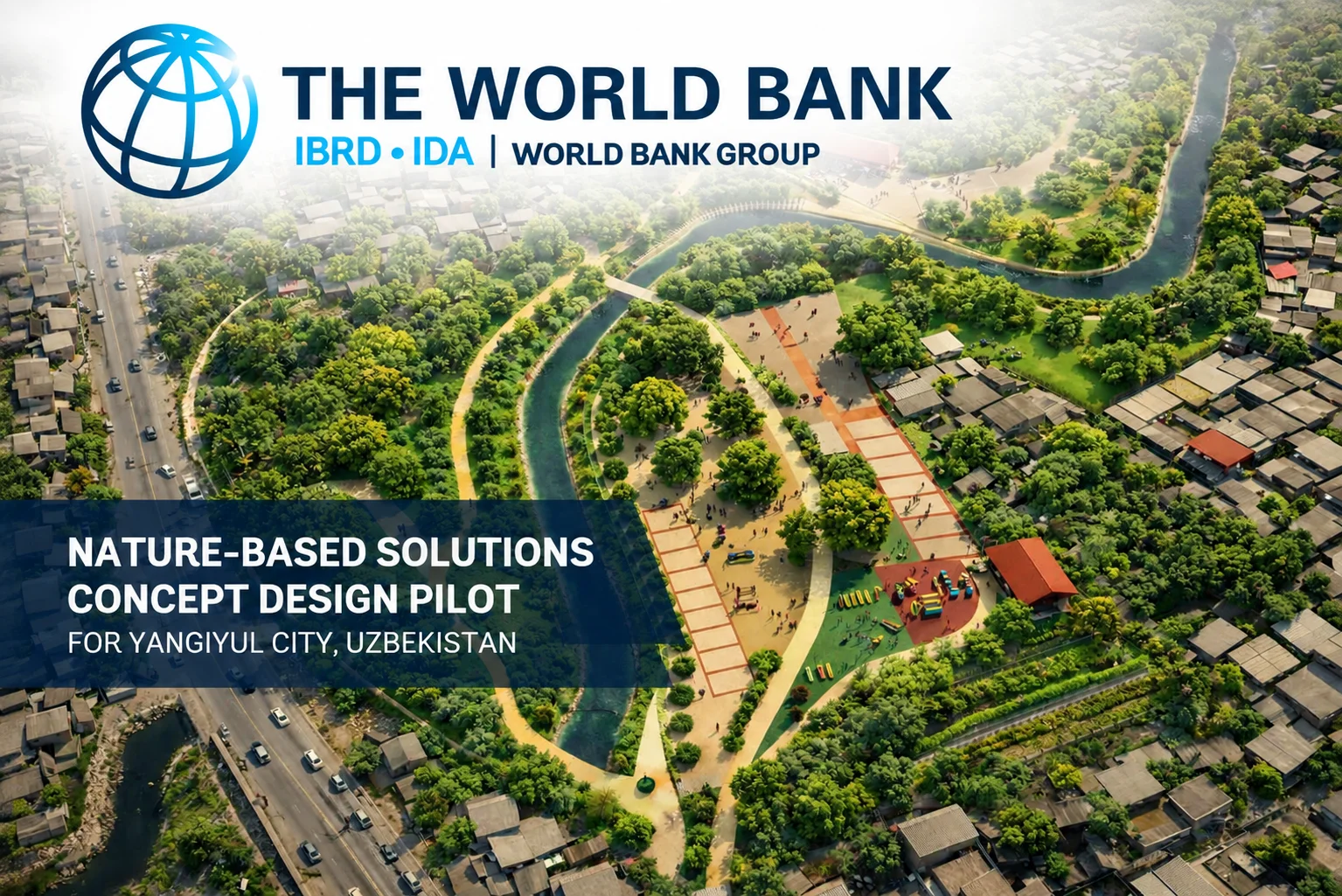
The Nature-Based Solution Concept Design Pilot for Yangiyul City project was implemented for the World Bank as part of the development of approaches to sustainable and climate-resilient urban planning in Uzbekistan.
The project’s main objective was to create a practical set of nature-based solutions that can be applied to restore degraded areas, manage stormwater, reduce flood and erosion risks, enhance biodiversity, improve the microclimate, and create high-quality public spaces.
The project considered three priority areas in Yangiyul: the Karakulduk stream area, the site of a former illegal landfill, and school grounds. The characteristic environmental, spatial, and infrastructure problems of each site were identified, and adapted NBS solutions were proposed.
Our role
HPBS developed a comprehensive approach to integrating Nature-Based Solutions into Yangiyul’s urban environment.
The work combined analysis of the areas’ existing condition, field surveys, a review of local regulatory requirements, stakeholder engagement, and the development of conceptual solutions.
Particular attention was paid to ensuring that the proposed NBS could be practically integrated into subsequent urban design and used as a tool for climate adaptation, environmental rehabilitation, and improvement of the urban environment.
Our services:
-
surveys and assessment of the existing condition of priority areas;
-
analysis of environmental, spatial, and infrastructure problems;
-
development of conceptual Nature-Based Solutions for different types of urban areas;
-
analysis of applicable local construction, sanitary, and other regulatory requirements;
-
analysis of permitting procedures and identification of regulatory constraints;
-
development of surface water and stormwater management solutions;
-
development of measures to reduce flood and erosion risks;
-
formulation of approaches to soil restoration and rehabilitation of degraded areas;
-
development of recommendations for enhancing biodiversity;
-
selection of landscaping principles and planting solutions;
-
development of solutions for improving public spaces;
-
integration of NBS into urban and landscape design;
-
consultations and working meetings with stakeholders;
-
preliminary cost-benefit analysis of the proposed solutions;
-
assessment of operational needs and maintenance costs for the solutions;
-
preparation of practical recommendations and guidelines for the further application of NBS in Yangiyul.
Areas of NBS application
The project considered three different types of urban areas:
-
Karakulduk stream — restoration of the area’s ecological functions, improved water runoff management, reduced flood risk, and creation of a high-quality public space;
-
site of the former illegal landfill — environmental rehabilitation, prevention of erosion and renewed contamination, landscaping, and creation of a public green area;
-
school grounds — slope stabilization, stormwater management, landscaping, and creation of shaded, safe, and comfortable spaces.
The project shows that Nature-Based Solutions can address several objectives simultaneously: water management, ecosystem restoration, greater climate resilience, improvement of the urban environment, and creation of additional social value.
Result
The project resulted in a systematic approach to applying nature-based solutions in Yangiyul’s priority areas.
The concepts and recommendations developed create a foundation for the further design and implementation of NBS, taking into account local natural conditions, the characteristics of the urban area, the regulatory framework, operational requirements, and user needs.
The project also provides a practical basis for scaling Nature-Based Solutions and integrating them into urban planning and sustainable territorial development processes in Uzbekistan.
Project significance
For Uzbekistan’s rapidly growing cities, nature-based solutions are becoming an important tool for climate change adaptation and improving the resilience of urban infrastructure.
Unlike the traditional approach, in which drainage, landscaping, public realm improvements, and land restoration are considered separately, NBS makes it possible to combine them into a unified system by using natural processes as part of urban infrastructure.
The World Bank project in Yangiyul is an example of how Nature-Based Solutions can be applied to address environmental, engineering, and social challenges simultaneously.
For HPBS, the project confirms the company’s expertise in Nature-Based Solutions, sustainable territorial development, climate adaptation, and the integration of environmental solutions into urban planning and design.
Additional information: