The document will download when the window opens.
CFD (Computational Fluid Dynamics)
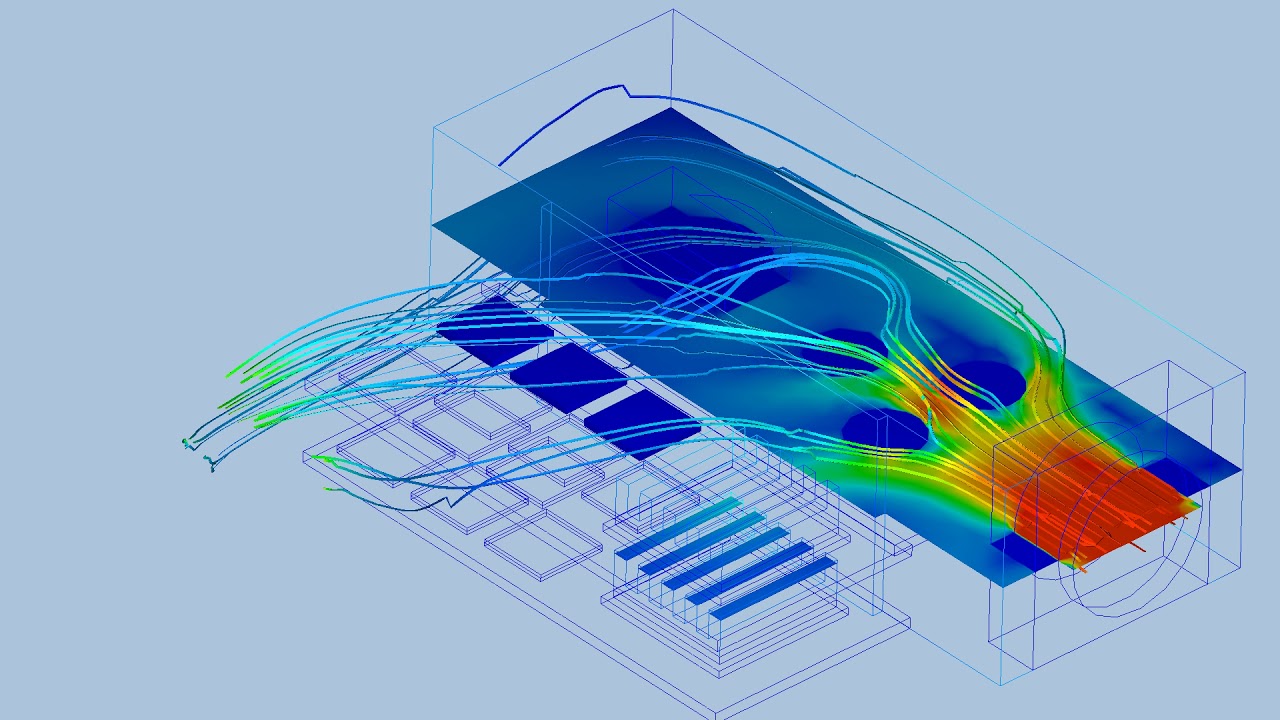
CFD (Computational Fluid Dynamics) is a computer modeling method that makes it possible to test engineering solutions for operability and assess their effectiveness and economic feasibility before construction work begins. This numerical modeling tool is especially useful at the design stage, when costs and return on investment must be thoroughly analyzed.
CFD provides the following capabilities:
-
Accurate calculation of temperature, humidity, carbon dioxide and other airborne contaminant concentrations, as well as the velocity of indoor airflows.
-
Modeling heat distribution in building structures under different operating conditions, taking into account the influence of the external and internal environment.
-
Analysis of temperatures on the surface of building elements, helping prevent condensation, for example on glazed facades.
-
Optimization of the placement of outdoor air-conditioning units and cooling towers to prevent overheating.
-
Selection of optimal configurations and parameters for heating, ventilation and air-conditioning systems.
-
Verification that design solutions provide comfortable thermal and humidity conditions.
-
Calculation of wind loads and assessment of pedestrian comfort when planning territories and building locations.
-
Determination of the optimal indoor air-distribution arrangement depending on the HVAC system used.
The model takes the following into account:
-
Architectural features of the building or space being analyzed.
-
Properties of building envelopes and materials.
-
External conditions (temperature, pressure, velocity and air changes).
-
Initial conditions, such as indoor air temperature.
CFD services from HPBS:
1.Heat-transfer calculations
Modern architectural solutions are becoming increasingly original, requiring careful development at the design stage. We use CFD to model heat-transfer processes for the following purposes:
-
Preventing condensation on the internal surfaces of structures.
-
Assessing the risk of freezing and overheating of structural assemblies.
2. Indoor microclimate calculations
Creating an optimal indoor microclimate is a key design objective. HPBS provides the following services:
-
Analysis of HVAC design solutions.
-
Calculation of temperature, humidity, air velocity, carbon dioxide and other contaminant concentrations.
-
Adjustment of design solutions to achieve optimal microclimate parameters.
-
Assessment of thermal comfort and calculation of PMV/PPD indices.
-
Determination of the optimal air-distribution arrangement.
3.Wind-load and pedestrian-comfort calculations
Modeling airflows around buildings makes it possible to assess wind loads and pedestrian comfort. CFD helps optimize the placement of buildings and infrastructure, especially when planning public areas and adjacent territories.
Benefits of CFD:
Using CFD modeling at the design stage saves money and improves construction quality:
-
Equipment optimization through detailed calculation of HVAC system loads, reducing capital costs.
-
Improved microclimate and selection of the correct parameters to increase comfort and reduce operating expenses.
-
Prevention of structural problems that may arise during building operation, avoiding additional future expenses.
Stages of providing the CFD service:
1. Analysis of current design solutions:
-
Creation of a mathematical model of the space being analyzed.
-
Calculation of temperature, humidity and air velocity, and verification of microclimate comfort.
-
Analysis of results and preparation of a report with recommendations.
-
Time frame: from 10 working days*.
2.Optimization of design solutions:
-
Development of measures to ensure optimal microclimate parameters.
-
Modeling and selection of the most effective solutions.
-
Assessment of the technical and economic effectiveness of the proposed measures.
-
Time frame: from 20 working days*.
3.Design support:
-
Agreement of final solutions with the client.
-
Development of terms of reference for adjusting the documentation.
-
Verification of selected equipment and final confirmation of design solutions.
-
Consulting for design teams.
*Time frames may vary depending on the project’s scope and complexity.
Additionally:
Get a consultation and proposal right now
We’re here to help

Anna Zavaleeva
CEO, HPBS Central Asia
Get a consultation and proposal right now
We’re here to help
Anna Zavaleeva
CEO, HPBS Central Asia