The document will download when the window opens.
Greenhouse Gas Emissions Accounting Course (Scope 1 & 2)
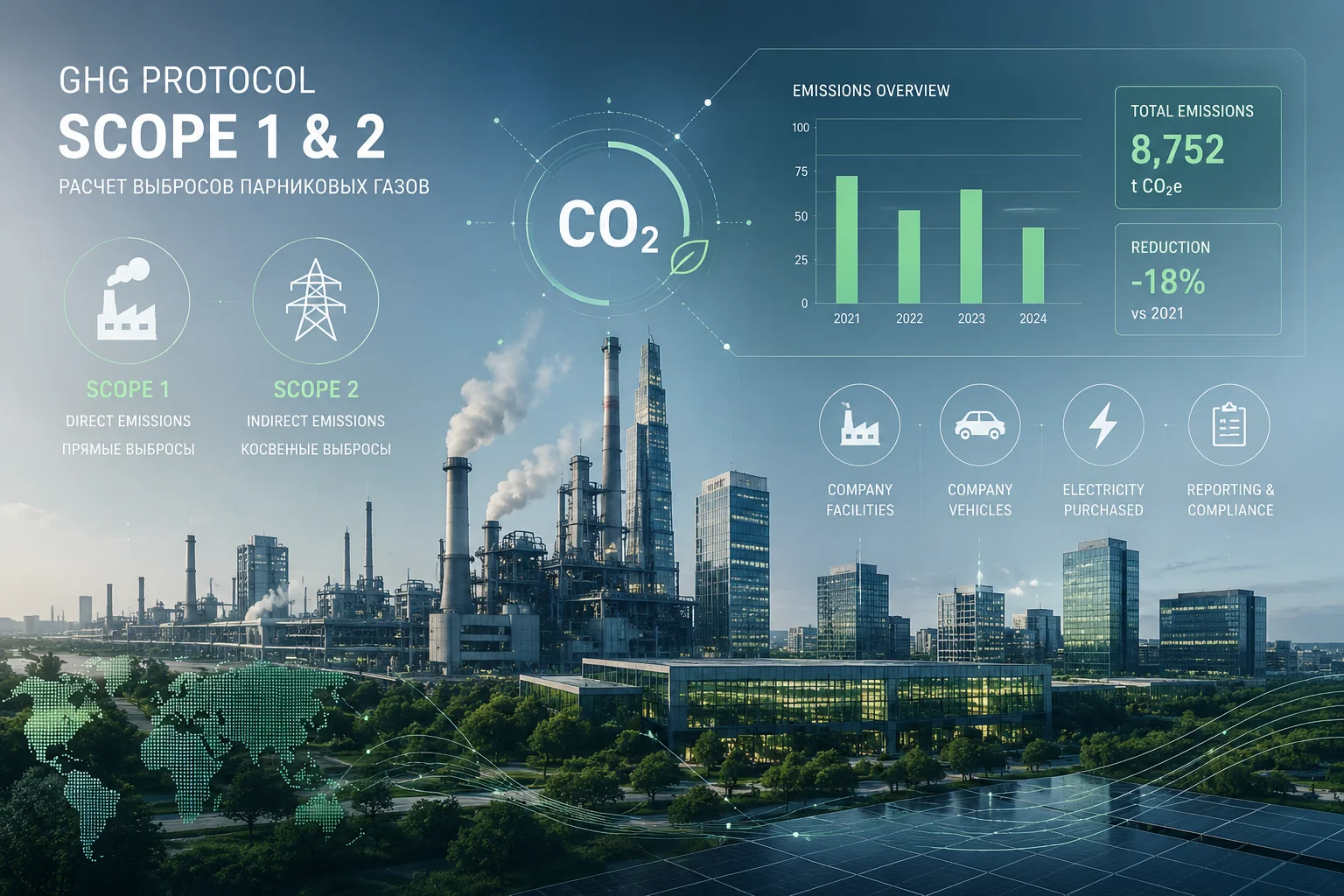
What Scope 1 and Scope 2 are and why they are needed
In international climate reporting practice, greenhouse gas emissions are divided into three scopes:
-
Scope 1 — direct emissions from sources controlled by the company. These include emissions from fuel combustion in boiler houses, furnaces and vehicles, as well as leaks of refrigerants and other greenhouse gases.
-
Scope 2 — indirect emissions from the consumption of purchased energy: electricity, heat, steam and cooling.
For most companies, Scope 1 and 2 provide the “foundation” for building a climate strategy and determining the corporate carbon footprint. Disclosure of these categories is mandatory under international standards — GHG Protocol, ISO 14064-1, IFRS S2, CDP and CSRD (EU).
Without correct Scope 1 and 2 accounting, it is impossible to:
-
compile a reliable emissions inventory;
-
pass reporting verification;
-
develop a climate strategy and SBTi targets;
-
meet the requirements of regulators and investors.
About the course
The “Scope 1 and 2: Inventory, Calculations and Reporting” course is designed for professionals who want to gain a clear understanding of the methodology, learn to collect and analyze data, and properly prepare climate reporting in accordance with international standards.
We combine theory, practice and real cases. Course participants will master a step-by-step calculation algorithm for Scope 1 and 2, examine examples from different industries and learn to work with emission factors.
What awaits you on the course
-
real-time training;
-
a convenient online format;
-
the opportunity to ask HPBS experts questions;
-
analysis of complex cases and examples from your practice;
-
work with international standards.
Who the course is intended for
-
sustainability and ESG professionals;
-
employees of environmental and environmental protection departments;
-
energy specialists and engineering services;
-
auditors and consultants;
-
§managers responsible for corporate reporting and strategy.
This course is right for you if you want to understand:
-
How should emissions sources be correctly identified under Scope 1 and Scope 2?
-
How should fuel and energy consumption data be collected and checked?
-
Which emission factors should be used?
-
How are Scope 1 and 2 related to ESG reporting and sustainable development goals?
-
How should data be prepared for verification and international reporting systems?
Upon completing the course, you will receive:
-
a complete understanding of the Scope 1 and Scope 2 structure;
-
a step-by-step methodology for calculating direct and indirect energy emissions;
-
practical skills in working with data and emission factors;
-
knowledge of international best practices and accounting tools;
-
confidence in preparing reporting that meets global requirements.
Course program
Module 1. Introduction
-
GHG Protocol concepts and principles.
-
Fundamentals of climate reporting and ESG.
-
The role of Scope 1 and Scope 2 in the corporate carbon footprint.
Module 2. Scope 1 — direct emissions
-
In-depth study of the GHG Protocol and ISO 14064-1 guidance applicable to the calculation of direct emissions.
-
Mastering methods for accounting for emissions from stationary and mobile fuel combustion, technological processes and refrigerant leaks.
-
Studying data sources: fuel balances, meter readings, waybills and refrigerant service logs.
-
Applying international factors to calculate emissions.
-
Developing the skills to select the most accurate methodology, taking into account the company’s specific characteristics and data availability.
Module 3. Scope 2 — indirect energy emissions
-
In-depth study of Scope 2 calculation methods in accordance with the GHG Protocol Scope 2 Guidance.
-
Mastering location-based and market-based approaches to calculating emissions from purchased electricity, heat, steam and cooling.
-
Studying data sources: electricity contracts and bills, data from energy suppliers and consumption figures by business unit.
-
Applying international factor databases and national power-system factors.
-
Developing the skills to select and substantiate the correct calculation method for reporting and verification.
Successful completion of the course is confirmed by a certificate that will serve as official evidence of your Scope 3 qualification. It is a significant competitive advantage in the labor market and an additional asset for developing your career in ESG and sustainable development.
Additionally
Greenhouse Gas Emissions Accounting Course (Scope 3)
Scope 3 Emissions Accounting Intensive
Get a consultation and proposal right now
We’re here to help

Anna Zavaleeva
CEO, HPBS Central Asia
Get a consultation and proposal right now
We’re here to help
Anna Zavaleeva
CEO, HPBS Central Asia