The document will download when the window opens.
Greenhouse Gas Emissions Accounting Course (Scope 3)
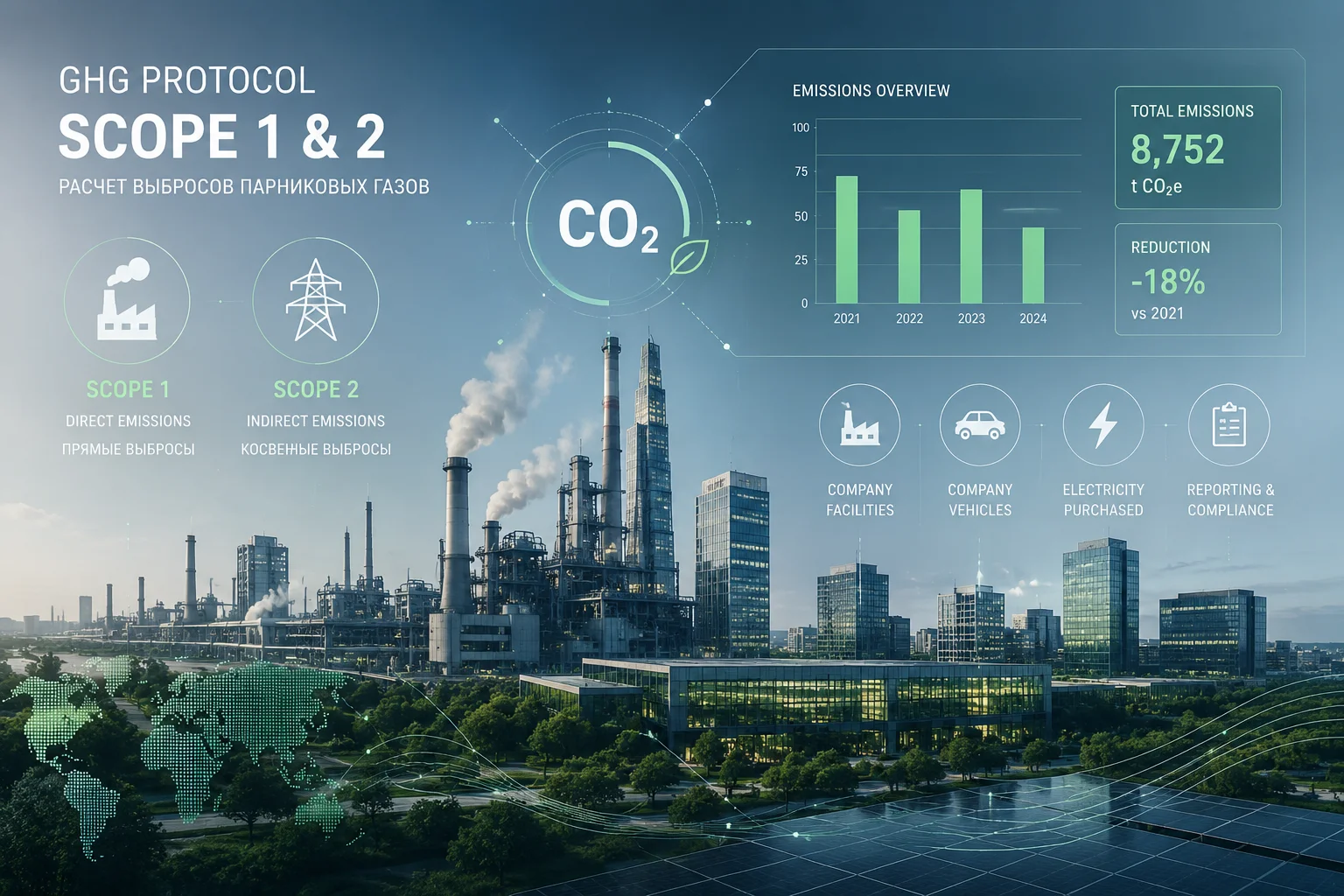
In climate reporting, companies conventionally distinguish three categories of greenhouse gas emissions:
-
Scope 1 — direct emissions from owned sources;
-
Scope 2 — indirect emissions from energy consumption;
-
Scope 3 — all other indirect emissions in the value chain.
Scope 3 (Scope 3) covers a wide range of impacts: the production of purchased goods and services, logistics, transport, business travel, and the use and disposal of products. For most companies, this category accounts for the largest share of their carbon footprint — more than 70–80%.
The international GHG Protocol Corporate Value Chain (Scope 3) Standard establishes the rules for calculating, assessing and disclosing such emissions. Today, without sound Scope 3 accounting, it is impossible to build a comprehensive climate strategy, prepare a reliable ESG report or pass external verification.
About the course
Our course, “Scope 3: Inventory, Calculations and Reporting,” is designed for professionals who need to gain an in-depth understanding of the methodology, learn to work with data and master internationally recognized tools.
The Scope 3 greenhouse gas emissions accounting course will give you the maximum amount of practical knowledge and strengthen your indirect-emissions calculation skills. HPBS experts will explain every Scope 3 emissions category, teach you to work with source data, review the factors used in calculations in detail, and devote special attention to one of the most complex categories of indirect emissions — Category 15, “Investments.”
Upon completing the course, you will acquire the skill of calculating greenhouse gas emissions under Scope 3 — one of the most difficult scopes to calculate!
What awaits you on the course:
-
real-time training;
-
a convenient online format;
-
the opportunity to ask the instructor questions directly;
-
analysis of unclear points in calculations and examples from your practice.
Who this course is intended for:
-
sustainability and ESG professionals;
-
employees of environmental and environmental protection departments;
-
procurement and supply chain management professionals;
-
auditors and consultants;
-
managers responsible for corporate reporting and strategy.
This course is suitable for everyone asking the following questions:
-
What constitutes an emissions source under Scope 3?
-
How should source data be handled?
-
How are life cycle assessment (LCA) and indirect emissions related?
-
Which guidance and methodologies should be used to calculate and prepare Scope 3 reporting?
-
How is Scope 3 reporting prepared?
-
What must be included in Scope 3 reporting, and what need not be?
-
How are greenhouse gas emissions calculated for each of the 15 Scope 3 categories?
Upon completing the course, you will receive:
-
a complete understanding of the Scope 3 structure and all 15 greenhouse gas emissions categories it covers;
-
a step-by-step calculation methodology for each category;
-
skills in working with different approaches to data collection and analysis;
-
knowledge of international best practices and GHG Protocol tools.
Course program
Module 1. Introduction
-
Key concepts and terms. Introduction to sustainable development and the climate agenda.
-
The theory and problem of climate change
-
The concept of sustainable development
-
Climate risks
-
Introduction to the carbon footprint.
Module 2. In-depth study of the greenhouse gas emissions categories covered by Scope 3
-
Study of the 15 Scope 3 emissions categories using examples from different industries.
-
Understanding the differences between upstream emissions (associated with suppliers, procurement and logistics before the company) and downstream emissions (arising when customers use and dispose of products).
-
Mastering a methodology for identifying the stages of the life cycle at which the largest carbon footprint is generated, and for prioritising categories for calculation and reporting.
Module 3. Scope 3 emissions calculation methodology
-
In-depth study of GHG Protocol guidance: Scope 3 Standard, Scope 3 Calculation Guidance.
-
Mastering the principal approaches and methods for calculating Scope 3 emissions.
-
Studying data sources: accounting systems, procurement databases, LCA study results, industry reference guides and emission factors.
-
Applying international standards and greenhouse gas emission factors.
-
Developing the skills to select an appropriate methodology based on data availability and the level of detail.
Module 4. Practice and cases in data collection and processing
-
Practising methods of engagement with suppliers and contractors: data requests, questionnaires and information validation.
-
Studying best practices for organising internal processes: assigning responsible persons, developing templates and controlling data quality.
-
Analysis of practical cases from different industries;
-
Developing skills for adapting the methodology to the specifics of a company.
Successful completion of the course is confirmed by a certificate that will serve as official evidence of your Scope 3 qualification. It is a significant competitive advantage in the labor market and an additional asset for developing your career in ESG and sustainable development.
Additionally
Greenhouse Gas Emissions Accounting Course (Scope 1 & 2)
Scope 3 Emissions Accounting Intensive
Get a consultation and proposal right now
We’re here to help

Anna Zavaleeva
CEO, HPBS Central Asia
Get a consultation and proposal right now
We’re here to help
Anna Zavaleeva
CEO, HPBS Central Asia