
Area: CBAM, industrial decarbonization, greenhouse gas emissions accounting and the product carbon footprint
Facility type: aluminum industry / industrial enterprise
Location: Republic of Tajikistan
Client: OJSC Tajik Aluminium Company (TALCO)
HPBS role: CBAM and carbon-regulation consultant / developer of the emissions-calculation and reporting methodology
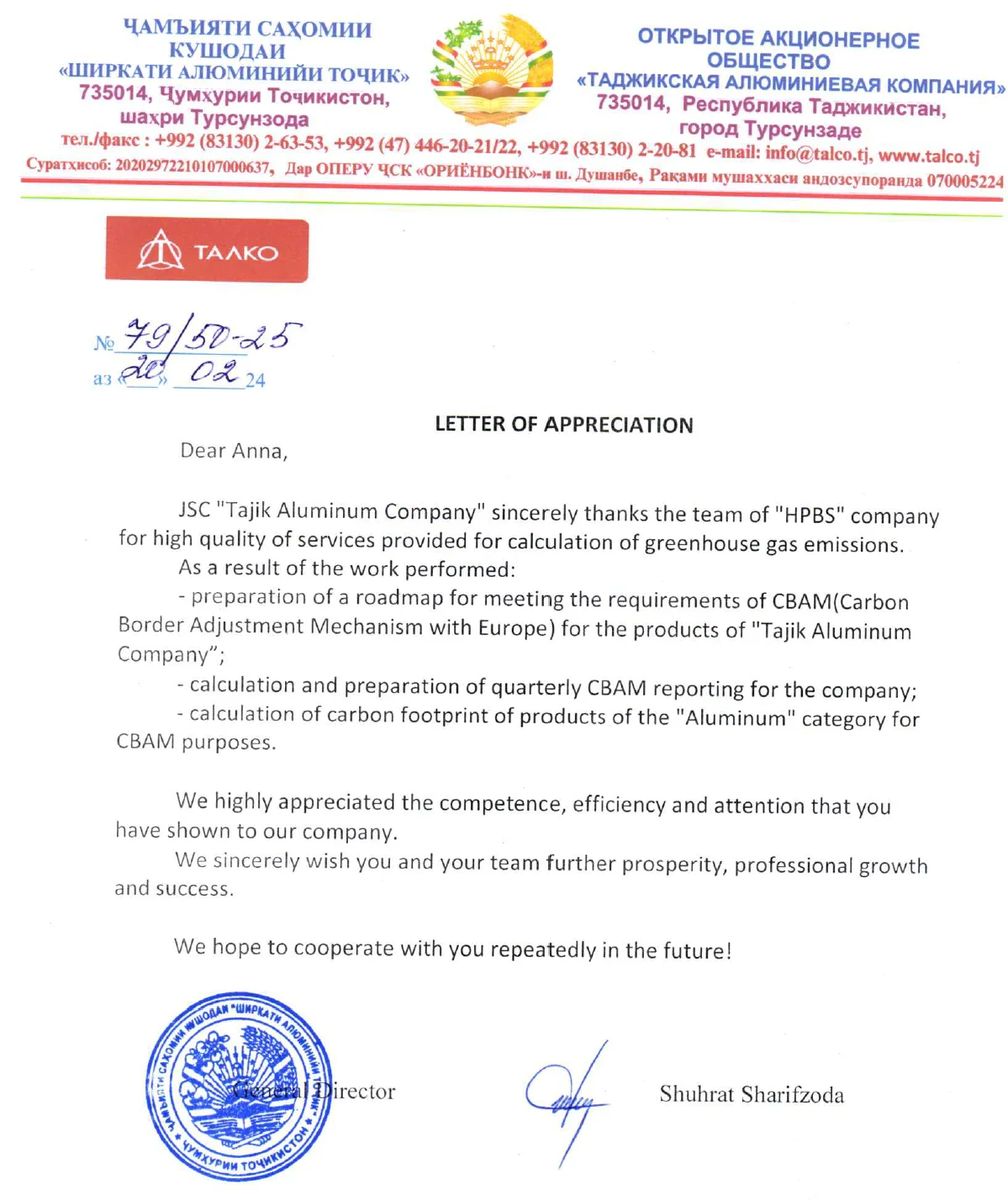
Result: preparation of a roadmap for complying with the requirements of the EU Carbon Border Adjustment Mechanism (CBAM), calculation and preparation of quarterly CBAM reporting, and calculation of the carbon footprint of products in the “Aluminium” category.
TALCO is one of Tajikistan’s largest industrial enterprises and a significant producer of aluminum products in Central Asia. For export-oriented industrial enterprises, European Union carbon-regulation requirements are becoming an important factor in international competitiveness, market access and product-cost management.
The HPBS project was aimed at establishing a practical system to prepare TALCO for the requirements of the Carbon Border Adjustment Mechanism — CBAM, including calculating embedded emissions, structuring source data, preparing reports and defining further steps to develop the corporate carbon-accounting system.
Our role
HPBS performed a comprehensive range of work to analyze the applicability of CBAM requirements to TALCO products, calculate greenhouse gas emissions and prepare reporting materials.
The work included analysis of production processes and emission sources, definition of calculation boundaries, collection and verification of source data, application of CBAM methodological requirements, calculation of the product carbon footprint and preparation of quarterly reports.
Particular attention was paid to creating a system that enables the enterprise to move from one-off calculations to regular data monitoring and preparation for further tightening of EU carbon-regulation requirements.
Our services:
-
analysis of the applicability of EU CBAM requirements to TALCO’s aluminum products;
-
analysis of the production chain and the main sources of direct and indirect emissions;
-
definition of the boundaries and parameters for calculating embedded emissions;
-
analysis of the availability and quality of source production data;
-
development of a data-collection structure for CBAM purposes;
-
selection and application of the appropriate emission factors;
-
calculation of direct and indirect emissions associated with the production of aluminum products;
-
calculation of products’ embedded emissions in accordance with CBAM requirements;
-
calculation of the carbon footprint of products in the “Aluminium” category;
-
preparation of quarterly CBAM reporting;
-
verification of the accuracy of calculations and reported data;
-
preparation of a roadmap for complying with CBAM requirements;
-
analysis of existing gaps in data and methodology;
-
preparation of recommendations for improving the monitoring, reporting and verification system;
-
consulting on the further development of the corporate GHG Accounting system;
-
preparation of recommendations for reducing the carbon intensity of products and increasing their competitiveness in export markets.
Assessment scope
The project covered several interconnected areas of carbon regulation:
-
CBAM Compliance — determination of CBAM requirements as applied to aluminum products;
-
Embedded Emissions — calculation of embedded product emissions;
-
Direct Emissions — accounting for direct emissions from production processes;
-
Indirect Emissions — analysis of emissions associated with the consumption of electricity and other energy resources;
-
Product Carbon Footprint — calculation of the carbon footprint of aluminum products;
-
MRV — development of approaches to monitoring, reporting and subsequent data verification;
-
Data Management — structuring source data and identifying data gaps;
-
Decarbonization — identification of avenues for further reducing production carbon intensity.
Result
As a result of the project, TALCO received a comprehensive foundation for preparing for European carbon-regulation requirements.
A roadmap for complying with CBAM requirements was developed for the company, emissions and the carbon footprint of aluminum products were calculated, and quarterly CBAM reporting was prepared.
The project made it possible to systematize the enterprise’s source data, identify key emission sources and determine directions for the further development of the corporate carbon-accounting and reporting system.
The results can be used as a basis for subsequent regular monitoring of embedded emissions, engagement with importers in the European Union and preparation for the financial phase of CBAM.
Project significance
For aluminum producers, the carbon intensity of products is becoming one of the key factors in international competitiveness. As CBAM develops, enterprises must not only know the volume of their own emissions, but also ensure source-data transparency, calculation traceability and compliance with international reporting requirements.
The TALCO project demonstrates the transition from a general understanding of carbon regulation to a practical system for calculating embedded emissions and preparing CBAM reports.
For HPBS, this project confirms the company’s expertise in CBAM, GHG Accounting, Product Carbon Footprint, MRV and industrial decarbonization, as well as its experience supporting a large export-oriented Central Asian enterprise under the European Union’s new carbon-regulation requirements.
Additionally: