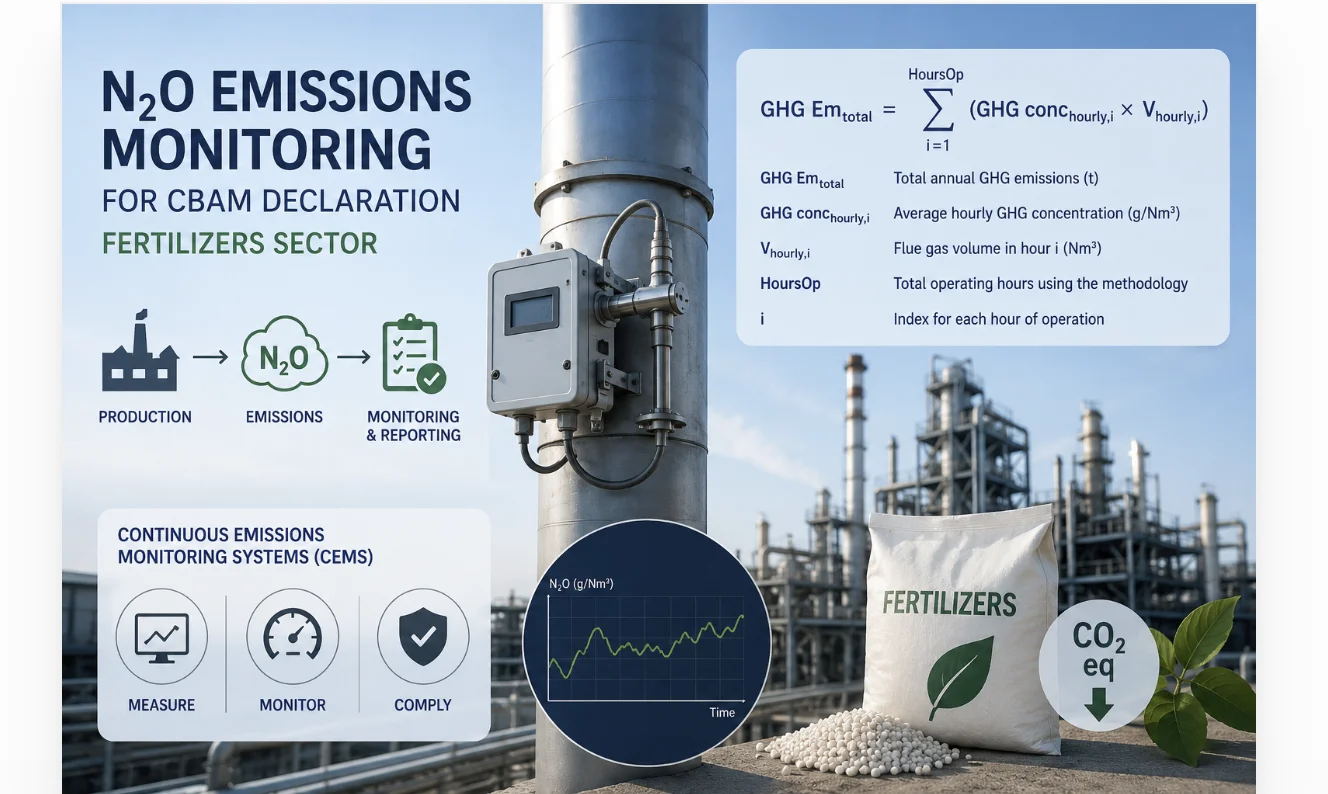
Conducting measurements to monitor N₂O emissions for the CBAM declaration, ‘Fertilisers’ category
From the CBAM methodology…
If emissions of N₂O are generated in the fertiliser-production sector as a result of a technological process rather than fuel combustion, the operator must monitor them using a continuous emissions monitoring system (CEMS) installed at an appropriate measurement point.
If there are several emission sources that cannot be monitored from a single point, the emissions from each such source must be monitored separately and the results summed for reporting purposes.
N₂O emissions are considered significant for monitoring only in nitric-acid production. However, where nitric acid or nitrates produced from it are used as a precursor, for example in the manufacture of compound fertilisers, the corresponding N₂O emissions form an integral part of the embedded emissions, expressed in tonnes of CO₂ equivalent:
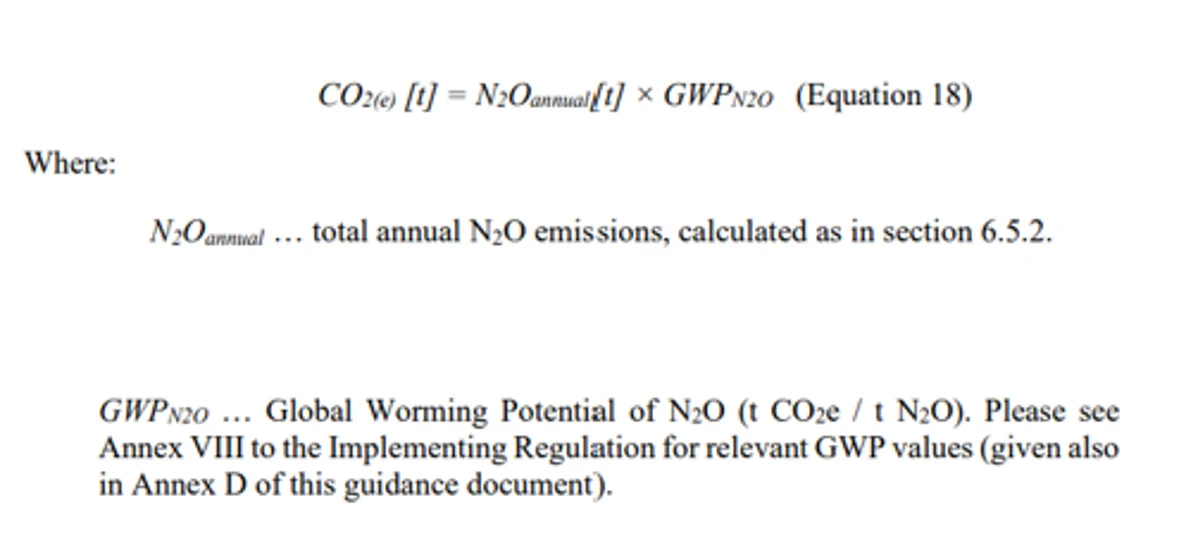
Detailed guidance on the Implementing Regulation’s requirements for CEMS under the CBAM methodology.
6.5.2 Continuous emissions monitoring systems (CEMS)
Unlike calculation-based approaches, greenhouse gases contained in an installation’s waste gases may be measured directly in the stack. This is difficult for installations with many emission sources — stacks — and effectively impossible where fugitive emissions must be taken into account. On the other hand, measurement-based methodologies have the advantage of being independent of the number of different fuels and materials used at the installation, for example where many different types of waste are incinerated.
The use of CEMS — continuous emissions monitoring systems — always requires two elements:
- measurement of greenhouse gas concentrations;
- measurement of the volumetric flow rate of the gas stream at the measurement location.
The CBAM Implementing Regulation requires a measurement-based approach to monitor N₂O emissions where nitrous oxide is identified as a relevant greenhouse gas for a good covered by CBAM, namely in the production of nitric acid and fertilisers.
Detailed requirements are set out in section B.6 of Annex III to the Implementing Regulation.
Calculating emissions for the reporting period — annual emissions

Where:
GHG Emₜₒₜₐₗ — total annual greenhouse gas emissions in tonnes;
GHG concₕₒᵤᵣₗᵧ,ᵢ — the hourly average concentration of greenhouse gas emissions in the flue-gas stream, measured during operation over hour or shorter calculation period i, expressed in g/Nm³;
Vₕₒᵤᵣₗᵧ,ᵢ — the volume of flue gas during hour i, expressed in Nm³ and determined by integrating the volumetric gas flow rate over that hour;
HoursOp — the total number of hours during which the measurement-based methodology is applied, including the hours for which data have been substituted in accordance with section B.6.2.6 of this Annex.
Index i refers to an individual hour of operation .
Hourly averages must be calculated as the average of all individual measurements taken during the relevant hour. Calculation periods other than full hours, such as half-hour intervals, may be used where this is better suited to the configuration of the measurement equipment or the requirements for other measurements performed at the installation.
CO₂ emissions from biomass
Where applicable, the quantity of CO₂ originating from biomass that meets the RED II criteria — see section 6.5.4 — may be deducted from the total measured CO₂ emissions.
One of the following methods must be used to determine the quantity of CO₂ emissions from biomass:
- A calculation-based methodology providing for the separate determination of the biomass fraction for each source stream used.
- Analysis and sampling methodologies in accordance with ISO 13833, ‘Stationary source emissions — Determination of the ratio of biomass (biogenic) and fossil-derived carbon dioxide — Radiocarbon sampling and determination’.
- A ‘balance method’ based on ISO 18466, ‘Stationary source emissions — Determination of the biogenic fraction in CO₂ in stack gas using the balance method’.
- Other methods based on international standards.
- Other methods permitted by the applicable monitoring, reporting and verification system — MRV; see section 6.5.3.
Determining flue-gas flow
Measuring flue-gas flow is challenging because measurement points must be selected so that the measurement results are representative of the entire cross-section of the stack. See also the quality requirements below.
As an alternative, the flow rate may therefore be calculated using an appropriate mass balance.
When calculating CO₂ emissions, such a balance must take into account:
- on the input side — all material parameters, including at least the quantity of feedstock and materials charged, the volume of incoming air and process efficiency;
- on the output side — at least the quantity of products produced and the concentrations of oxygen O₂, sulphur dioxide SO₂ and nitrogen oxides NOₓ.
Handling gaps in measurement data
Where continuous monitoring equipment for a specific parameter was out of control, out of range or not operating during part of an hour or other calculation period, the corresponding hourly average must be calculated pro rata on the basis of the remaining data points for that hour or shorter calculation period.
This is permitted provided that at least 80% of the maximum possible number of data points for the relevant parameter are available.
Where less than 80% of the maximum possible number of data points for a parameter are available, the following calculation is used:
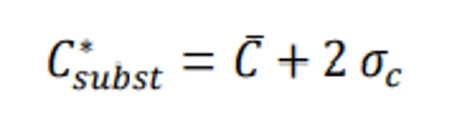
Where:
C̄ — the arithmetic mean of the concentration of the relevant parameter over the entire reporting period or, where data loss occurred under specific circumstances, over an appropriate period reflecting those circumstances;
σc — the best estimate of the standard deviation of the concentration of the relevant parameter over the entire reporting period or, where data loss occurred under specific circumstances, over an appropriate period reflecting those circumstances.
If the reporting period is not suitable for determining such substitute values because of material technical changes at the installation, another sufficiently representative time interval must be selected to determine the mean and standard deviation. Where possible, it should be at least six months long.
For parameters other than concentration, substitute values must be determined using an appropriate mass-balance model or process energy-balance model.
Such a model must be validated using the remaining measured parameters of the measurement-based methodology and data obtained under normal operating conditions. The period considered must be equal in duration to the period for which data are missing.
Measurement quality requirements
All measurements must be performed using methods based on international standards such as:
- ISO 20181:2023, ‘Stationary source emissions — Quality assurance of automated measuring systems’;
- ISO 14164:1999, ‘Stationary source emissions — Determination of the volume flowrate of gas streams in ducts — Automated method’;
- ISO 14385-1:2014, ‘Stationary source emissions — Greenhouse gases — Part 1: Calibration of automated measuring systems’;
- ISO 14385-2:2014, ‘Stationary source emissions — Greenhouse gases — Part 2: Ongoing quality control of automated measuring systems’;
- other applicable ISO standards, in particular ISO 16911-2, ‘Stationary source emissions — Manual and automatic determination of velocity and volume flow rate in ducts’.
Where no applicable published standards are available, suitable draft standards, best-industry-practice guidelines or other scientifically sound methodologies that minimise systematic bias in sampling and measurement must be used.
All material aspects of the continuous monitoring system must be taken into account, including:
- equipment location;
- calibration;
- measurement;
- quality assurance;
- quality control.
Laboratory competence requirements are set out in section 6.5.1.4 of the methodology
Additional requirements
CO₂ emissions determined using a measurement-based methodology must be corroborated by calculating the annual emissions of each relevant greenhouse gas for the same emission sources and source streams.
For this purpose, the requirements for calculation-based approaches may be simplified as appropriate.
Where CO₂ emissions are measured, any quantities of carbon monoxide CO emitted must be accounted for as the molar equivalent amount of CO₂.
6.5.3 Special methods applicable in countries outside the EU
The Implementing Regulation defines an ‘acceptable MRV system’ as follows:
‘Acceptable monitoring, reporting and verification system’ means a monitoring, reporting and verification system where the installation is established for the purposes of a carbon pricing scheme, or compulsory emission monitoring schemes, or an emission monitoring scheme at the installation which can include verification by an accredited verifier, in accordance with Article 4(2) of this Regulation.
Article 4(2) permits monitoring approaches provided for by an acceptable MRV system to be used until 31 December 2024, provided that they ensure similar coverage and accuracy of emissions data compared with the methods set out in Annex III to the Implementing Regulation, namely the calculation-based and measurement-based approaches discussed in sections 6.5.1 and 6.5.2.
In practice, for the operator of an installation producing goods that will be imported into the EU and are subject to CBAM, this means the following:
- a monitoring methodology must be developed as soon as possible. Importers will need the first emissions data to submit the first report by the end of January 2024. It must report the embedded emissions of goods imported between October and December 2023;
- if the installation is already covered by an acceptable MRV system, the operator does not need to start from scratch. During the transitional period until the end of 2024, it may use at least some of the data obtained under that system.
How can it be determined whether an installation is covered by an acceptable MRV system and whether the methods it provides may be used during the initial stage of CBAM implementation?
This is possible if at least one of the following conditions is met:
- the installation participates in a carbon-pricing scheme. This may be an emissions trading system — ETS — or a carbon tax, levy or charge. For the scheme to be considered acceptable, participation must be mandatory and regulated by law, meaning that established rules for monitoring greenhouse gas emissions exist;
- the installation participates in a mandatory greenhouse-gas emissions reporting system. In this case, only monitoring and reporting, and possibly verification, are mandatory, but carbon pricing does not apply;
- the installation participates in a voluntary installation-level emissions monitoring system, which may provide for verification by an accredited verifier. For such a system to be recognized as acceptable, it must likewise have an established set of monitoring rules approved by a recognized regulatory or governing authority. Some greenhouse-gas emissions reduction projects may fall under this definition, such as projects under the UN Clean Development Mechanism — CDM.
In all cases, before applying the rules of such an MRV system, it is necessary to verify whether they ensure comparable coverage and accuracy of emissions data.
Additional information: