The document will download when the window opens.
CBAM (Carbon Border Adjustment Mechanism) Course
What CBAM is and who needs it
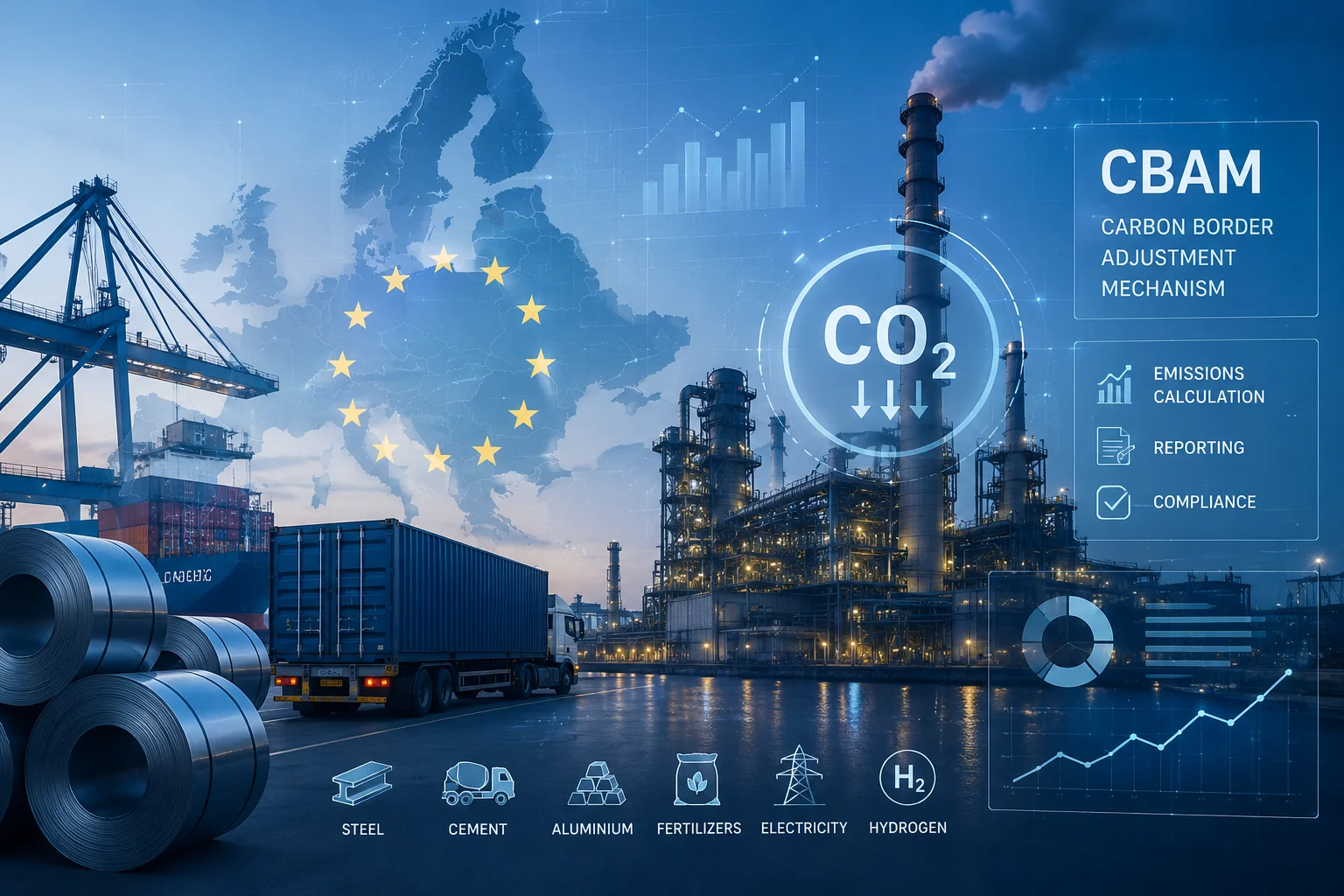
CBAM (Carbon Border Adjustment Mechanism) is the European carbon border adjustment mechanism created to level the “carbon playing field” between European producers and importers.
In the EU, companies already pay for greenhouse gas (GHG) emissions generated by the production of goods under the EU ETS (Emissions Trading System). To prevent foreign suppliers from having a competitive advantage and businesses from moving production outside the EU, importers will be charged for the carbon footprint of their products.
For the current period through 2026, goods subject to CBAM requirements include:
-
Iron and steel
-
Cement
-
Aluminum
-
Fertilizers
-
Electricity
-
Hydrogen
Since October 1, 2023, CBAM has operated in a transitional mode: companies importing goods subject to the requirements into the EU must submit a quarterly report on emissions associated with their production.
On January 1, 2026, CBAM will become fully operational: importers of listed goods (steel and other ferrous metals, cement, aluminum, fertilizers, electricity and hydrogen) will be required not only to report, but also to purchase special CBAM certificates reflecting the volume of emissions generated in producing their goods.
About the course
The CBAM course is intended for professionals who need to understand the new regulatory system, learn to calculate embedded emissions correctly and prepare reports in accordance with European Commission requirements.
The course program combines a theoretical foundation, EU legislation and practical industry cases.
Course outcomes
During the course, you will:
-
Learn what the CBAM mechanism is and which companies are subject to its requirements;
-
work through the entire CBAM process step by step;
-
learn to calculate GHG emissions under CBAM rules;
Who the course is intended for
-
Executives and professionals in ESG/sustainable development and climate reporting;
-
Procurement, supply and SCM professionals working with suppliers and collecting primary data;
-
Customs, Trade Compliance and foreign-trade unit professionals responsible for compliance with new EU regulations;
-
Financial professionals and economists planning CBAM budgets, contracts and carbon pricing;
-
Producers outside the EU that supply goods on the CBAM list to the EU.
Course program
Module 1. Introduction to CBAM
-
Study of the essence of the Carbon Border Adjustment Mechanism (CBAM) and its role in EU climate policy.
-
Understanding the objectives of CBAM: leveling the “carbon playing field” for European producers and importers and preventing carbon leakage.
-
Review of the implementation stages:
transitional period (2023–2025) — reporting without payments;
definitive phase (from 2026) — mandatory purchase and surrender of certificates.
-
Overview of the sectors and product groups covered by CBAM (steel and ferrous metals, cement, aluminum, fertilizers, electricity and hydrogen).
Module 2. Goods and CN codes
-
Detailed study of the sectors and product categories covered by CBAM (steel and ferrous metals, cement, aluminum, fertilizers, electricity and hydrogen).
-
Study of the rules for classifying goods under Combined Nomenclature codes (CN codes) in accordance with EU customs legislation.
-
Practice in building a compliance matrix.
Module 3. Calculation of embedded emissions
-
Detailed study of the CBAM methodology for calculating embedded emissions.
-
Mastering the calculation structure: direct emissions and indirect emissions.
-
Study of data sources.
-
Review of approaches to calculating GHG emissions.
Upon completing the course, you will receive an official certificate confirming your qualification in emissions accounting under the CBAM methodology. This document will be a significant competitive advantage in the labor market and an additional asset for developing your career in ESG and climate reporting.
Get a consultation and proposal right now
We’re here to help

Anna Zavaleeva
CEO, HPBS Central Asia
Get a consultation and proposal right now
We’re here to help
Anna Zavaleeva
CEO, HPBS Central Asia